Two Vietnam Train Journeys Rank Among the World’s Best in 2026
Last updated: October 26, 2026

From the spectacular railway winding along Hai Van Pass to a luxury train journey through the countryside of Central Vietnam, two Vietnamese rail experiences have earned places among the world’s 20 best train journeys in Condé Nast Traveler’s 2026 Readers’ Choice Awards. Their recognition offers a different perspective on exploring Vietnam: sometimes, the journey itself is as memorable as the destination.
Some train journeys are simply a way to travel between cities. Others make you want to stay by the window a little longer, watching landscapes unfold and enjoying the changing scenery along the way.
In Central Vietnam, rail travel offers exactly that kind of experience.
One journey connects the historic city of Hue with coastal Da Nang, following a remarkable railway through the mountains of Hai Van Pass, with sweeping views of the sea and Lang Co Bay.
The other, The Vietage by Anantara, takes a more luxurious approach, carrying travelers through rice fields, rural villages and coastal landscapes while combining scenic travel with fine dining and personalized service.
Different in character but equally distinctive, both journeys have received international recognition.
On October 6, 2026, American travel magazine Condé Nast Traveler announced the results of its 39th annual Readers’ Choice Awards, based on 798,867 votes collected between April 1 and June 30, 2026.
Among the 20 rail journeys recognized, the Hue–Da Nang Heritage Train ranked 10th, while The Vietage by Anantara placed 14th.
For travelers planning a trip to Vietnam, the ranking offers more than another reason to visit Central Vietnam. It highlights a slower, more immersive way to discover the country, where getting from one destination to another becomes part of the adventure.
Why Train Travel Offers a Different Way to Experience Vietnam
In an age when speed and convenience often shape travel decisions, trains offer something increasingly valuable: time to appreciate the journey.
Flying may be the fastest way to cover long distances, but much of the landscape below remains hidden behind clouds.
Traveling by train is different.
Beyond the window, scenery changes gradually. Busy neighborhoods give way to farmland, mountains and stretches of coastline. Small villages appear and disappear, while everyday life continues beside the tracks.
There is no need to stop at every viewpoint or rush to capture every photograph.
Travelers can simply sit back and watch.
That is part of the appeal of slow travel, an approach that values the experience of moving through a place rather than focusing only on arrival.
In Vietnam, where railway lines pass through varied landscapes and communities, traveling by train can reveal a side of the country that visitors might otherwise miss.
Hue to Da Nang: Three Hours Through One of Vietnam’s Most Scenic Railway Routes
Of the two journeys recognized by Condé Nast Traveler, the Hue–Da Nang route is particularly remarkable for its natural scenery.
Introduced in early 2024 as the Central Heritage Connection train, the approximately three-hour journey links two of Central Vietnam’s most important destinations.
Along the way, passengers travel past the Tam Giang–Cau Hai lagoon system, Lang Co Bay and the spectacular Hai Van Pass.
This is where mountains meet the sea.
As the train approaches Hai Van Pass, the railway curves along forested slopes, revealing changing views of the coastline below.
On one side, green mountains rise above the tracks. On the other, the landscape opens towards blue water, sandy beaches and the sweeping curve of Lang Co Bay.
The scenery becomes the highlight of the journey.
At certain points, the train follows the mountainside, creating the impression of traveling between two worlds: rugged hills above and the vast sea below.
For international visitors exploring Vietnam for the first time, the journey offers a memorable introduction to the country’s central coastline.
Hai Van Pass: Where the Journey Becomes the Experience
Hai Van Pass has long been regarded as one of Vietnam’s most spectacular coastal routes.
But seeing it from a train offers a different perspective from traveling by car or motorbike.
Passengers do not have to concentrate on winding roads or traffic. Instead, they can devote their attention entirely to the landscape outside.
As the railway follows the mountain slopes, Lang Co Bay and the surrounding coastline appear from different angles.
Light, clouds and weather can transform the view from one journey to the next.
On clear days, passengers may enjoy expansive views across the sea. When low clouds drift across the mountains, the landscape takes on a quieter, more atmospheric character.
This changing scenery means the experience is never entirely the same.
Even on a familiar route, nature has a way of making every journey feel different.
More Than Scenery: Discovering Central Vietnamese Culture on Board
The Hue–Da Nang Heritage Train offers more than beautiful views.
According to the published details of the service, the train includes two community carriages designed to introduce passengers to local culture.
Traditional music and dance performances provide opportunities to experience elements of Central Vietnam’s cultural heritage while traveling.
This gives the journey a character that goes beyond ordinary transportation.
Passengers can enjoy the scenery while learning something about the region they are passing through.
For visitors exploring Hue and Da Nang on the same itinerary, the railway becomes more than a connection between two cities.
It creates a transition between two different cultural environments.
At one end lies Hue, the former imperial capital, celebrated for its royal heritage, historic architecture and longstanding traditions.
At the other is Da Nang, a modern coastal city and gateway to many of Central Vietnam’s most popular destinations.
The three hours between them offer an opportunity to experience the landscape that connects these two places.
The Vietage by Anantara: A Luxury Railway Experience Through Central Vietnam
While the Hue–Da Nang train is celebrated for its scenic route and cultural experiences, The Vietage by Anantara offers a different interpretation of rail travel.
Ranked 14th in Condé Nast Traveler’s 2026 list, The Vietage provides luxury railway carriage experiences connecting Da Nang, Quy Nhon and Nha Trang.
Rather than treating travel time as something to minimize, the experience is built around enjoying the journey itself.
Outside the windows, passengers can watch rice fields, rural villages and coastal mountains pass by.
Inside, the atmosphere is designed for comfort, relaxation and attentive service.
The contrast between the countryside outside and the refined surroundings on board gives the journey its distinctive appeal.
This is not a train ride where passengers simply wait to arrive.
The hours spent traveling are an important part of the experience.
Da Nang to Quy Nhon: Six Hours of Scenery and Fine Dining
The journey between Da Nang and Quy Nhon takes approximately six hours.
During the trip, passengers can enjoy a three-course meal combining Vietnamese and French culinary influences.
Rather than having a quick meal before continuing their itinerary, travelers dine while the train moves through Central Vietnam’s countryside.
Outside, fields, villages and mountains gradually pass by.
Inside, the meal becomes part of a carefully arranged travel experience.
This combination creates a different rhythm.
There is time to enjoy the food, appreciate the service, have a conversation and watch the landscape without needing to move from one attraction to another.
For travelers who value comfort and memorable dining experiences, the journey offers an appealing alternative to conventional transportation.
Quy Nhon to Nha Trang: Afternoon Tea Along the Coast
The Vietage’s Quy Nhon–Nha Trang journey continues the experience with a focus on relaxation.
Passengers can enjoy afternoon tea featuring local products while traveling through the coastal landscapes of Central Vietnam.
It is an approach that combines sightseeing with the atmosphere of a luxury holiday.
Instead of considering the journey between two destinations as lost time, The Vietage transforms those hours into an experience of their own.
That philosophy reflects an important aspect of contemporary luxury travel.
Value does not come only from prestigious destinations or elegant facilities.
It also comes from the way each part of a journey is experienced.
Two Train Journeys, Two Ways to Discover Central Vietnam
Although both rail experiences earned places in Condé Nast Traveler’s Readers’ Choice Awards, they appeal to different kinds of travelers.
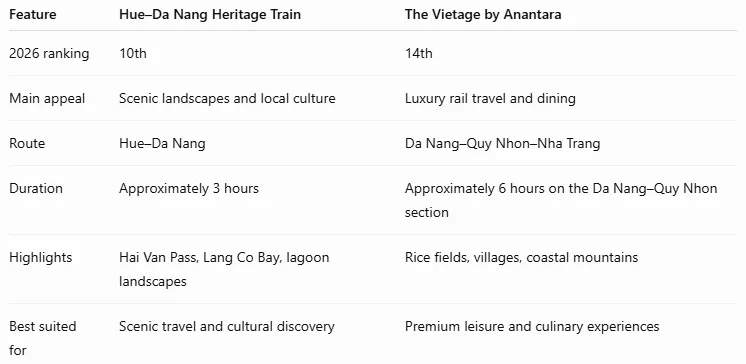
For nature lovers, photographers and travelers interested in local culture, the Hue–Da Nang train offers an attractive way to experience Central Vietnam.
The Vietage, meanwhile, is particularly appealing to travelers who want to combine sightseeing with fine dining, comfort and a more exclusive atmosphere.
Neither experience is necessarily better than the other.
The right choice depends on what travelers hope to enjoy along the way.
Why Consider Train Travel on a Vietnam Itinerary?
Many international visitors plan their Vietnam journeys around well-known destinations such as Hanoi, Ha Long Bay, Hue, Hoi An, Da Nang, Nha Trang and Ho Chi Minh City.
Transportation between these places is often treated as a practical detail to be optimized for speed.
But scenic rail journeys suggest that the fastest option is not always the most rewarding.
Traveling by train allows visitors to observe how the landscape changes between cities and rural areas, plains and mountains, farmland and coastlines.
Not every scene outside the window is a famous attraction.
Sometimes it is simply a rice field, a small village or a stretch of coastline visible for a few minutes.
Yet these ordinary moments can contribute to a deeper understanding of a destination.
Rail travel can also offer a welcome opportunity to relax between sightseeing days, particularly for visitors who prefer not to spend every journey on the road or in the air.
Of course, choosing a train should still depend on practical considerations, including schedules, journey times and individual travel preferences.
Slow Travel Doesn’t Necessarily Mean Seeing Less
Slow travel is often associated with spending more time in one destination.
But it can also begin with how we choose to move between places.
Instead of trying to shorten every journey, travelers may choose transportation that allows them to observe, relax and connect with their surroundings.
Three hours on a train winding through Hai Van Pass can offer a very different experience from three hours on a highway.
Likewise, six hours aboard a luxury railway carriage can become an opportunity to enjoy a memorable meal and watch the countryside unfold.
In both cases, the value lies in more than the distance traveled.
It comes from the experience of traveling that distance.
For Vietnam, where landscapes and local cultures change significantly from region to region, railway journeys offer an especially appealing way to discover the country.
Vietnam Among the World’s Most Admired Rail Journeys
Having two Vietnamese railway experiences recognized in Condé Nast Traveler’s 2026 list is a notable moment for the country’s travel industry.
The ranking was led by the Venice Simplon-Orient-Express, one of Europe’s most celebrated luxury trains.
Its journeys take passengers through the French countryside and the Swiss mountains, combining daytime sightseeing with elegant onboard experiences.
Other recognized rail adventures include the Jungfrau Railway in Switzerland, journeys across Central Asia, rail travel through Australia’s wilderness and Canyon Spirit in the United States.
Alongside these internationally known experiences, the Hue–Da Nang Heritage Train and The Vietage demonstrate the appeal of rail travel in Vietnam.
It is important, however, to understand the nature of the recognition.
Condé Nast Traveler’s Readers’ Choice Awards reflect reader preferences and voting rather than an independent technical assessment of every railway journey worldwide.
The ranking is therefore best understood as a reflection of the travel experiences appreciated by participating readers.
For Vietnam, it provides another opportunity to introduce international visitors to the country’s landscapes and distinctive ways of traveling.
Sometimes the Best Memories Happen Between Destinations
There is something interesting about the way we remember travel.
We often plan our holidays around destinations: a city we want to visit, a historic site we hope to see or a beach where we want to spend a few days.
Yet when the journey is over, some of the most memorable moments may come from the time spent between those places.
A quiet morning on a train as sunlight enters through the window.
An unexpected curve revealing a beautiful bay.
A leisurely meal while rice fields pass outside.
Or simply a few hours without rushing, watching a landscape gradually unfold.
The recognition of two Vietnamese railway journeys in Condé Nast Traveler’s 2026 Readers’ Choice Awards is a reminder of that experience.
From the dramatic curves of Hai Van Pass to the refined carriages traveling through Central Vietnam’s coastal countryside, each journey reveals a different side of the country.
For travelers planning to explore Vietnam, perhaps it is worth thinking beyond the familiar question:
“Where should we go?”
And asking another:
“How do we want to experience the journey getting there?”
Because sometimes, the most memorable part of a trip begins long before reaching the destination.